


Select A Store
Select Store
My Store:
Select A Store
Availability:
$10.49
Used
-
Trade Paperback
-
9780674979857
Overview
Overview
A New York Times #1 Bestseller
An Amazon #1 Bestseller
A Wall Street Journal #1 Bestseller
A USA Today Bestseller
A Sunday Times Bestseller
Winner of the Financial Times and McKinsey Business Book of the Year Award
Winner of the British Academy Medal
Finalist, National Book Critics Circle Award
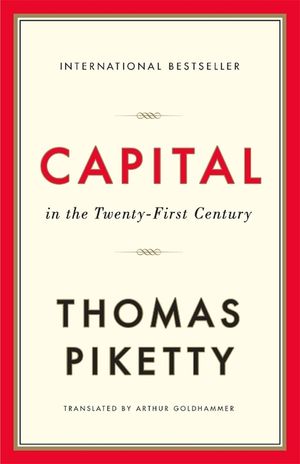
"It seems safe to say that Capital in the Twenty-First Century, the magnum opus of the French economist Thomas Piketty, will be the most important economics book of the year--and maybe of the decade."
--Paul Krugman, New York Times
"The book aims to revolutionize the way people think about the economic history of the past two centuries. It may well manage the feat."
--The Economist
"Piketty's Capital in the Twenty-First Century is an intellectual tour de force, a triumph of economic history over the theoretical, mathematical modeling that has come to dominate the economics profession in recent years."
--Steven Pearlstein, Washington Post
"Piketty has written an extraordinarily important book...In its scale and sweep it brings us back to the founders of political economy."
--Martin Wolf, Financial Times
"A sweeping account of rising inequality...Piketty has written a book that nobody interested in a defining issue of our era can afford to ignore."
--John Cassidy, New Yorker
"Stands a fair chance of becoming the most influential work of economics yet published in our young century. It is the most important study of inequality in over fifty years."
--Timothy Shenk, The Nation
- Format: TradePaperback
- Author: Piketty, Thomas
- ISBN: 9780674979857
- Condition: Used
- Dimensions: 8.40 x 1.80
- Number Of Pages: 816
- Publication Year: 2017
Customer Reviews
Rating Snapshot
5 ★
100%
4 ★
0%
3 ★
0%
2 ★
0%
1 ★
0%
1 Ratings
0
0% Would Recommend
0 Recommendations
Review Images
Sort by:
-
Treatise on how concentrated wealth undermines democracy
Wallace S. - 3 years 3 months agoEconomics was famously called "the dismal science" by Thomas Carlyle, and oftentimes it's not hard to see why. Yet Piketty's Capital in the Twenty-First Century is a masterwork of clear, concise writing, as well as being an astounding piece of scholarship. Piketty examines what seems like every available piece of data in regards to wealth and capital and in doing so detects clear patterns, as well as important irregularities, in the nature of wealth inequality. The author shows the gains made in living standards and wealth inequality in the 20th Century in many Western countries to be more of an accident than a natural law of capitalism. The tendency is towards high concentration of wealth at the top and Piketty goes on to discuss the many ways in which this is dangerous, and how democratic societies can tackle the problem. A brilliant, well-written examination of a problem that continues to undermine the very notion of democracy.
HPB Staff Review