


Select A Store
Select Store
My Store:
Select A Store
Availability:
$7.99
Used
-
Trade Paperback
-
9780143123644
Overview
Overview
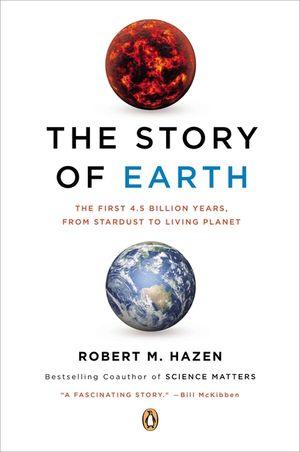
Hailed by The New York Times for writing "with wonderful clarity about science . . . that effortlessly teaches as it zips along," nationally bestselling author Robert M. Hazen offers a radical new approach to Earth history in this intertwined tale of the planet's living and nonliving spheres. With an astrobiologist's imagination, a historian's perspective, and a naturalist's eye, Hazen calls upon twenty-first-century discoveries that have revolutionized geology and enabled scientists to envision Earth's many iterations in vivid detail--from the mile-high lava tides of its infancy to the early organisms responsible for more than two-thirds of the mineral varieties beneath our feet. Lucid, controversial, and on the cutting edge of its field, The Story of Earth is popular science of the highest order. "A sweeping rip-roaring yarn of immense scope, from the birth of the elements in the stars to meditations on the future habitability of our world." -Science "A fascinating story." -Bill McKibben
- Format: TradePaperback
- Author: Hazen, Robert M.
- ISBN: 9780143123644
- Condition: Used
- Dimensions: 7.90 x 0.70
- Number Of Pages: 320
- Publication Year: 2013
Customer Reviews
Rating Snapshot
5 ★
100%
4 ★
0%
3 ★
0%
2 ★
0%
1 ★
0%
1 Ratings
0
0% Would Recommend
0 Recommendations
Review Images
Sort by:
-
The Story of Earth
Ralph M. - 6 years agoHazen, Robert M., 2012. The Story of Earth. Penguin Books, 306 pp. You’re probably familiar with the pale blue dot, the photograph of Earth taken from Voyager I. But the Earth wasn’t always so, once it would have been a pale red dot, like Mars is now, and at another time, a pale white dot. You’d think nothing new would come out of mineralogy, wouldn’t you? Except, of course, the discovery - once in a while - of new minerals. You’d be wrong. Back in 2008, Robert Hazen, together with several colleagues, realized that minerals evolve. Not in the same way as animals, or plants, or even bacteria - all of which evolve in somewhat different fashions. Of course, individual minerals don’t evolve, any more than individual animals; your pet dog, hamster, hedgehog or cat (if you must) or, for that matter, you. But over time, the suite of minerals on the earth has grown and diversified, as the chemistry of the earth itself changed with time. This is what makes this book, among all those that recount the history of the earth, special. It gives a new perspective, that will enrich your understanding of our planet. Hazen sets out the history of the earth, as now understood, in parallel with the history of the suite of minerals. Some minerals pre-date the earth, and so the story begins with the creation of the very first minerals in the atmospheres of exploding stars, and the afterglow of the Big Bang - not in that order, of course. The chapters of Hazen’s book are (mostly) named for colors, the successive colors that the earth would show from space, determined by the prominent minerals at the surface. It’s well-written and easily read and understood. And if you don’t care to read it, Hazen has produced one of the Great Courses illustrated lecture series that you can watch on DVD (and yes I did find mine at a local Half-Price), or stream. Either (or both) will change the way you look at minerals - if you’re the sort that looks at minerals - and your appreciation of our planet. Of more critical importance, it delineates yet another way in which the inhabitants and components of our planet, living and non-living, are intertwined and entangled.